
Insights
The Real Cost of We Have Always Done It This Way

Engaged SCM | Warehouse Modernization Series
A new warehouse associate asks why the team prints a pick list, walks it over to a supervisor for a signature, and then scans the same items into the system.
“That’s how we’ve always done it.”
Sometimes the original reason for a step has been lost. Sometimes the people doing the work know exactly what would go wrong if they skipped it. The signature might still catch a shipping error. Or it might be a step the team kept after the system changed.
Either way, the best place to start is with the people who do the work. Ask what the step was put in place to prevent, whether that problem still comes up, and what happens on a busy shift when someone skips it. Those answers help you decide what’s worth keeping and where the team could get some time back.
A Habit Is Usually a Preserved Solution
Most long-standing practices on a warehouse floor began as a sensible answer to a real problem. The signature was added after a shipping error three years ago. The extra stock at the line was set aside after a stockout stopped production. The spreadsheet appeared because the old system could not produce the report that a supervisor needed on Monday morning.
Over time, the circumstances change. The system gets upgraded, the supplier improves, the original problem fades. The practice stays, because it is now part of how the team works, and the person who created it has moved on. What remains is the step without the reason.
This matters because it changes how leaders should respond. If a practice is a preserved solution, then the useful question is not why people resist change. It is what problem the practice was solving, and whether that problem still exists.
Where It Shows Up on the Floor
The pattern appears in many forms, and most of them are small enough to escape attention.
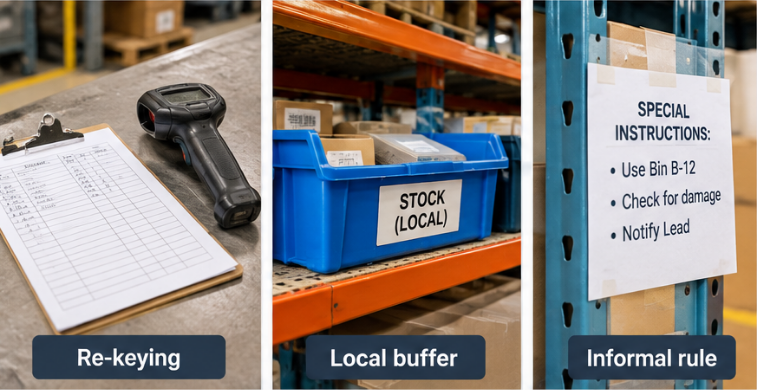
- Re-keying. Information is captured on paper or in a spreadsheet and then entered into the system later, sometimes by a different person.
- Double handling. Material is moved to a staging spot, then moved again before it is used, because that is the established flow.
- Local buffers. A team holds a private supply of critical items near the point of use, outside the system, because the formal supply has let them down before.
- Verification loops. People walk to a location to confirm what the system says before they trust it.
- Informal rules. Priorities, sequences, and exceptions that live in someone’s memory instead of in standard work.
None of these looks expensive on its own. Taken together, they shape how much labour, space, and working capital the operation consumes.
What It Costs
Because these practices are spread across many small tasks, their combined cost is rarely calculated. The example below is illustrative. Every figure is an assumption, not a client result.
Consider a single distribution site and three legacy practices.
First, paper records re-keyed into the system. Four people spend 1.5 hours a day on this over 250 working days. That is 1,500 hours a year. At a loaded labour rate of $38 an hour, the cost is $57,000.
Second, double handling. Suppose 400 pallet moves a week are repeated only because "that is the flow." At four minutes each, across 52 weeks, that is about 1,390 hours a year, or roughly $53,000.
Third, informal buffers held at the point of use. If they amount to 3% of a $10 million inventory, that is $300,000 of stock outside any planning logic. At a 20% annual carrying cost, the cost is $60,000.
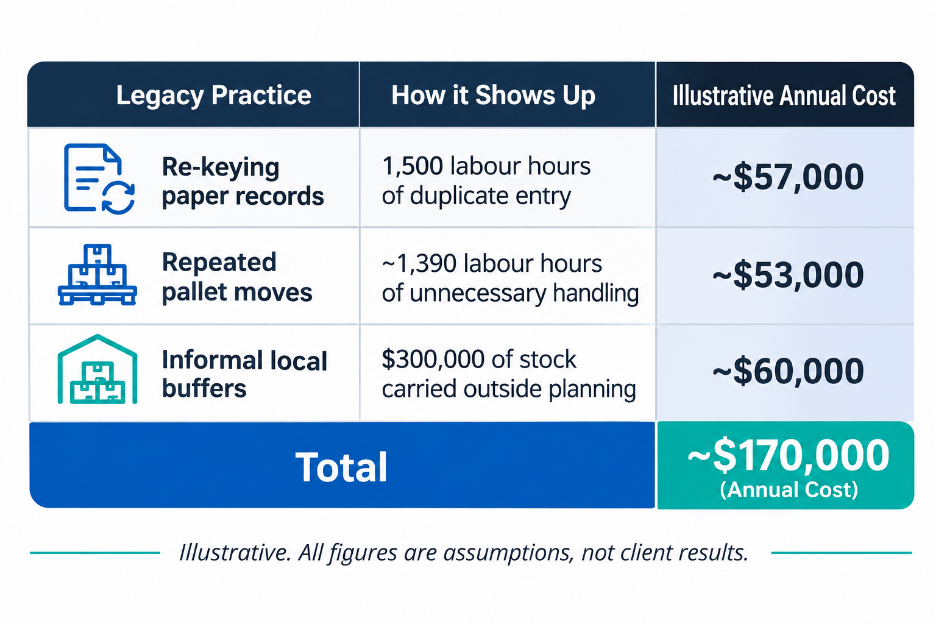
In this example, re-keying and repeat pallet moves use about 2,900 labour hours a year, valued at $110,000. That’s time the team could put toward picking, replenishment, or other work. If the full $300,000 buffer is excess stock, reducing it could free up that working capital for other uses. At an assumed 20% carrying rate, holding that stock represents an estimated $60,000 in annual carrying costs. The example leaves out the impact of errors and delays. And when a new system goes live, these practices can carry over into it. We explored that dynamic in our article Go-Live Is an Operational Milestone, Not an IT Milestone.
Why These Practices Persist
The research suggests that persistence is not mainly a matter of attitude.
In a widely cited paper in MIS Quarterly, Polites and Karahanna examined why people keep using familiar systems when a new one is available. They found that habitual use of the incumbent system, perceived transition costs, and a sense of sunk costs all encouraged inertia, and that inertia was associated with resistance to the new system even when users recognized its advantages. Inertia also colored how users perceived the new system’s ease of use. On the floor, this means a team can agree that a new process is better and still drift back to the old one, because the old one is what their hands know.
A second line of research explains how workarounds become permanent. Tucker and Edmondson conducted field research with 26 nurses in nine hospitals and documented how frontline workers met small operational failures, such as missing supplies or wrong information, and typically solved them on the spot rather than addressing the cause. The authors described an illusory equilibrium in which these small failures erode organizational effectiveness instead of prompting learning and change.
Hospitals are not warehouses, but the dynamic is familiar. A picker who finds a way around a mislabelled location gets the order out and moves on. The mislabel stays in place for the next shift. Each person acted sensibly. The workaround solved the immediate problem and, in doing so, removed the pressure to fix the underlying one.
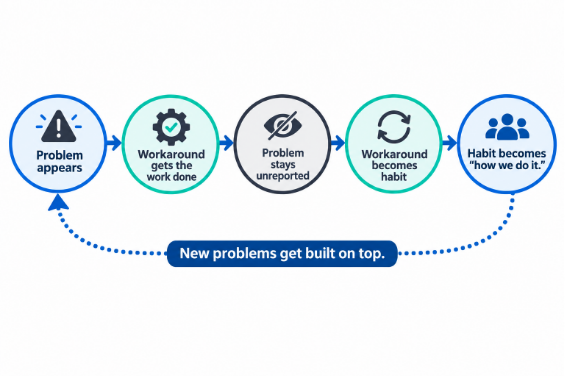
Put the two findings together and the pattern becomes clearer. People develop a workaround to get through a real obstacle. Repetition turns it into a habit. The habit then becomes the way things are done, and the obstacle it was built to handle is forgotten.
Why Telling People to Stop Rarely Works
When leaders notice a legacy practice, the instinct is often to issue an instruction: stop doing that. Compliance may follow for a while. The practice tends to return when pressure rises, because the problem that created it has not been addressed.
We described a version of this in The Inventory Black Box No One Owns. Maintenance teams stage material early because they have been caught short before. Telling them to stop does not solve the trust gap. Until the supply process earns confidence, the buffer will keep reappearing.
The more productive approach is to treat each legacy practice as a piece of information. It points to a problem that someone once felt strongly enough to solve. Understanding that problem is the first step toward a better solution.
A Practical Way to Review Legacy Practices
A structured review can replace debate with evidence. We use a simple keep, change, or retire process.
- Collect the list. Ask each shift, operators and supervisors alike, to name the steps that exist because "that is how we have always done it." Walk the floor to confirm what is actually happening.
- Ask four questions of each practice. What problem was this solving? Does that problem still exist? What does it cost in time, space, or capital? What would replace it?
- Decide. Keep it and document the reason, change it, or retire it.
- Pilot before rolling out. Test the change on one shift or one area, and measure the result against the cost estimate.
- Write the reason down. Put the "why" into standard work so the next team inherits the step and its purpose together.
One point deserves emphasis. The person who knows a practice best is usually the person who has been performing it. Making that person part of the review, rather than the subject of it, improves the quality of the answers and the chance that the change holds.
The Leadership Role
Leaders influence this more than they might expect, through three habits.
The first is to replace "we have always done it this way" with "here is why we do it this way." A team that can explain the reason for each step can also tell when the reason no longer applies.
The second is to give problems a path to a fix. The research above suggests that workarounds become permanent when nobody owns the underlying cause. A short, visible route from a reported problem to a corrected process makes it more worthwhile to raise issues instead of absorbing them.
The third is to treat workarounds as data. Each one marks a place where the process, the system, or the supply of materials did not meet the needs of the job. Collected over time, they form a practical improvement list written by the people closest to the work.
Where to Start
A legacy practice can take only a few minutes each time. Across a shift, a week, or a year, those minutes add up. Start by looking at how the work gets done and asking which steps still serve a purpose.
Take the signed pick list. Ask the picker and the supervisor what the signature is meant to catch. If the check still matters, keep it in place while you test whether the system can catch the same errors. Run the test on one shift and track both the time spent and the errors caught. Then decide whether to keep, change, or retire the step and document why.
That’s how we approach Operational Improvement at Engaged SCM. We work with teams to clarify processes, build standard work, and put the right controls in place. Through the Sustain step, we stay engaged as supervisors coach their teams and check that the changes are working across shifts.
The next time someone says, “We’ve always done it this way,” ask them to show you the step and tell you what it helps them get done.
About the Author
Brent Willett is Founding Principal of Engaged SCM Inc., a supply chain advisory firm that helps asset-heavy industrial organizations make better operational and technology decisions, then shows up to deliver them.
Brent is a Chartered Professional Accountant with senior advisory experience at Deloitte and EY. He is the former board chair and interim CEO of Supply Chain Canada (Alberta Institute) and currently serves as a strategic advisor to the Alberta Logistics Centre of Excellence.
Connect with Brent on LinkedIn.
Is Your Bottom Line Paying for a Broken Process?
Most asset-heavy operations have hidden inefficiencies that technology alone will not fix. We find them, build the plan, and stay engaged until the results are real.
