
Insights
The Illusion of Inventory Accuracy: Why 98% Isn't Good Enough

By Brent Willett
Engaged SCM | Warehouse Modernization Series
Most warehouse leaders report inventory accuracy somewhere between 96% and 98%.
On paper, that sounds strong. Dashboards stay green. Executive updates show control. Leadership assumes the operation is performing as expected.
Then the floor tells a different story.
Pickers cannot find material. Orders get short-shipped. Supervisors escalate missing inventory. Customer service starts chasing status updates. Operations teams build manual workarounds just to keep throughput moving.
That is the problem with inventory accuracy as a KPI. It measures reporting confidence, not operational reliability.
A warehouse can report 98% inventory accuracy and still fail hundreds of times a day.
The Math Most Operations Underestimate
A 2% inventory error rate does not sound significant until it is applied to a live operation.
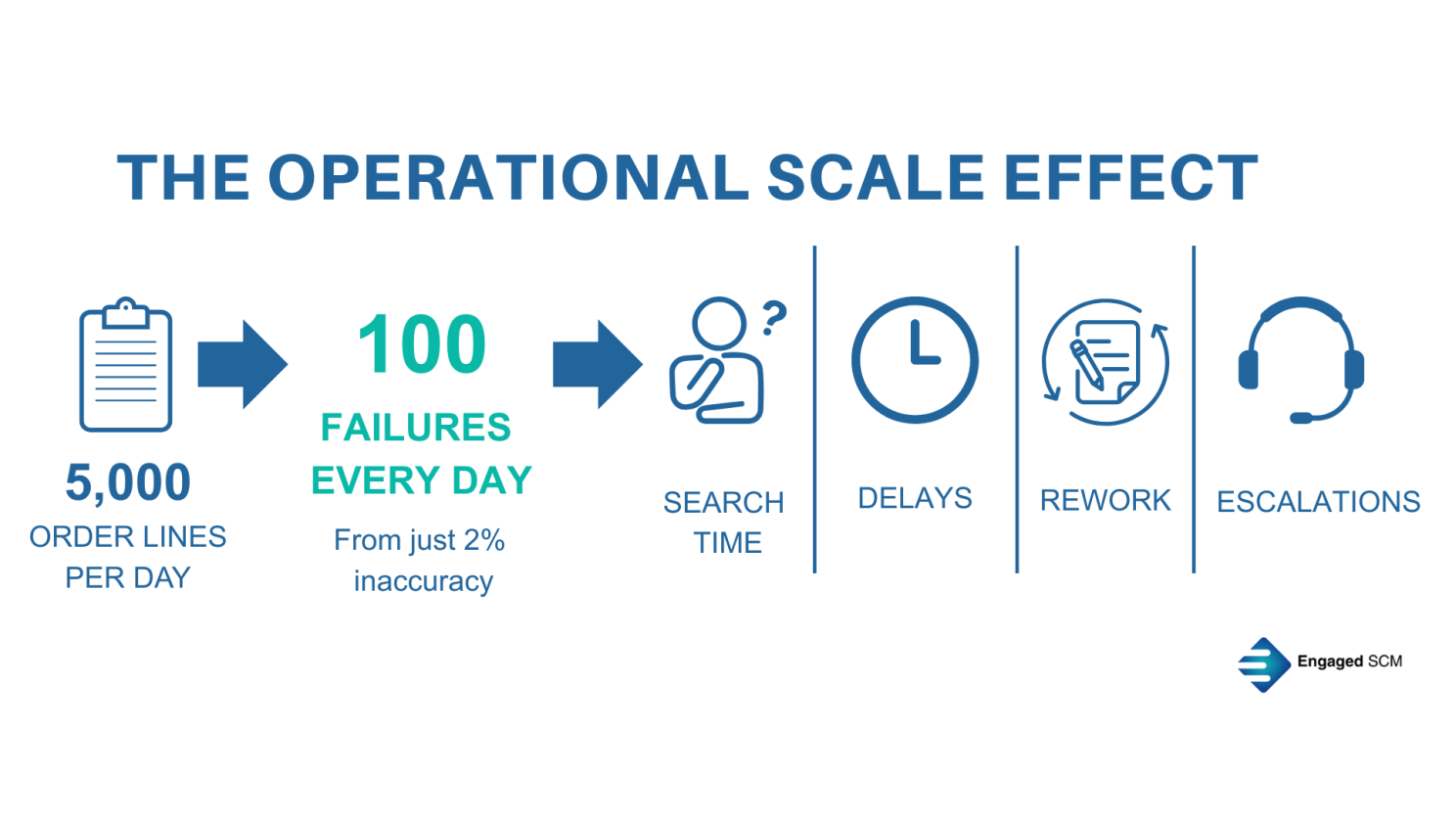
A distribution center processing 5,000 order lines per day at 98% accuracy creates roughly 100 inventory-related failures daily.
Not once a week. Not occasionally. Every single day.
Each failure creates operational drag. A picker searches for missing material. A supervisor investigates. Another order gets delayed. Someone adjusts inventory manually. Customer service gets involved. Expedite costs rise. Throughput slows.
None of those activities generate value. They consume labor capacity that should be focused on execution.
According to data published by Voxware, the average cost of a warehouse mis-pick ranges from $30 to $75 per incident, with annual losses reaching hundreds of thousands of dollars per facility. Those costs rarely show up cleanly in one line item. They spread across labor, freight, customer service, inventory adjustments, and lost productivity.
Most organizations see the symptoms individually. Few connect them back to inventory reliability.
That disconnect is where operational performance starts to erode.
Accuracy Is Not the Same as Reliability
Most inventory programs still define accuracy with a simple question: does the system quantity match the physical count? That definition works for audit purposes, but it does not work operationally. Warehouses are dynamic environments where inventory constantly moves through receiving, putaway, replenishment, picking, staging, packing, and shipping. Conditions change hourly. Priorities shift daily. A cycle count may confirm inventory was correct at one moment in time, but that does not mean the operation can execute reliably when pressure increases.
What matters operationally is whether the material is exactly where the system says it is when the operation needs it. Can the picker trust the location? Can replenishment execute without searching? Can supervisors make decisions confidently without second-guessing the WMS? That is the difference between inventory accuracy and operational reliability.
Many operations report strong inventory accuracy while still struggling with delays, searches, missing inventory, and constant manual intervention throughout the day. The issue is not the reported KPI. The issue is the gap between what the system says should happen and what the floor can actually execute. Operations do not fail during cycle counts. They fail during execution.
Where Inventory Accuracy Actually Breaks Down
Inventory discrepancies rarely originate where they are discovered.
When a picker cannot find material in a forward location, the issue usually started much earlier upstream in the operation. Most organizations know this instinctively, but many still treat inventory errors as isolated incidents instead of process failures moving through the system.
Receiving is often where the breakdown begins. Inbound volume spikes. Trailers stack up. Pressure builds to move product quickly. Verification steps get rushed, compressed, or skipped entirely. Inventory enters the system incorrectly before it ever reaches a storage location, and from that point forward the operation is already working from unreliable information.
The problems compound from there. Incorrect putaway transactions, rushed scans, mixed SKUs, and partial moves create inventory that technically exists in the WMS but cannot be reliably accessed operationally. The system reflects one reality. The floor reflects another. Replenishment then feeds forward pick locations using flawed data, creating fragmented inventory across the facility and forcing teams to rely on tribal knowledge instead of system direction.
Eventually the operation adapts through workarounds. Supervisors make manual adjustments. Teams search alternate locations. Variances get corrected transactionally without ever addressing the root cause. The numbers may improve temporarily, but the operational instability remains. That is why small percentage gaps in inventory accuracy create outsized operational consequences at scale.
The Real Danger Is the Workaround Culture
When teams stop trusting inventory, they adapt. Not through formal redesign or structured process improvement, but through behavior. “Check the next aisle.” “Look in overstock.” “It might still be on the dock.” “Just move it manually.” Every warehouse develops these habits when inventory reliability breaks down long enough.
Leaders often normalize these workarounds because the operation continues moving. Orders still ship. Production still runs. Customers still get served most of the time. But workarounds are not operational strength. They are operational debt. Every manual search increases travel time. Every undocumented move weakens inventory integrity further. Every exception process adds more variability into the operation.
Over time the warehouse stops operating through process discipline and starts operating through institutional memory. Teams rely on experience instead of system direction. Scalability disappears because the operation depends on specific people knowing where the problems are hiding. At that point inventory accuracy is no longer just a data issue. It becomes a system design issue affecting the entire operation.
The Operational Cost Multiplies Fast
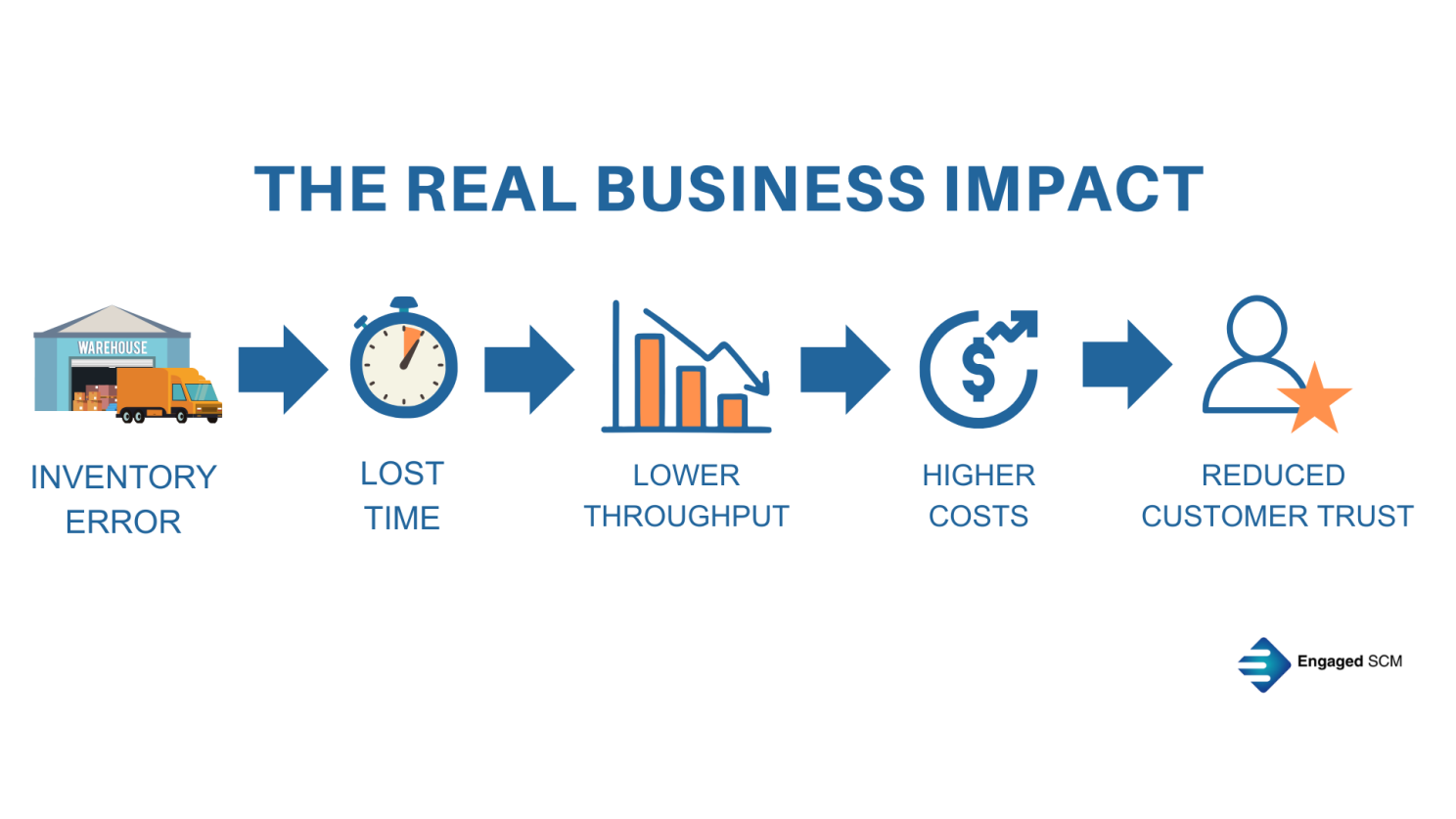
Inventory inaccuracies never stay contained to inventory. They spread across the operation quickly and quietly. Labor productivity is usually the first area impacted. Teams spend more time searching, investigating, and escalating instead of executing. Travel increases. Supervisors get pulled into exception handling. Skilled employees spend their shifts chasing missing product instead of moving work forward.
Order fulfillment performance then begins to deteriorate. Picking slows down. Packing waits on material. Shipping windows tighten. Expedite activity increases. Priorities constantly shift because planners and supervisors stop trusting the inventory visibility inside the system. Eventually customer service absorbs the downstream impact through delayed shipments, incomplete orders, and rising customer frustration.
The financial damage compounds in the background. More safety stock gets introduced to compensate for uncertainty. Working capital increases. Inventory carrying costs rise. Additional labor gets added to stabilize operational symptoms instead of addressing root causes. Most organizations underestimate how much margin erosion starts with unreliable inventory data because the costs spread across multiple departments instead of appearing in one visible place.
Why Traditional KPIs Miss the Problem
Most warehouse dashboards still reduce inventory accuracy to a single percentage. That KPI may look useful in an executive update, but operationally it reveals very little. It does not show where discrepancies originate. It does not measure how often execution gets interrupted. It does not quantify labor wasted searching for inventory or expose which processes are creating instability.
A warehouse can report strong inventory accuracy while floor teams openly admit they do not trust the system. That contradiction exists in more operations than most leaders realize. The dashboard reflects reported performance while the floor reflects operational reality. The gap between those two conditions is where most execution problems live.
The issue is not that organizations lack KPIs. Most operations already have too many. The problem is they measure outcomes without measuring reliability. High-performing operations understand that inventory accuracy is not simply a reporting metric. It is an operational capability that directly impacts throughput, labor productivity, customer service, and financial performance.
What Strong Warehouse Operations Do Differently
Operations with reliable inventory control approach the problem differently. They do not treat inventory accuracy as a monthly reporting exercise or a cycle count outcome. They build operational discipline directly into warehouse execution every day. Receiving becomes a control point, not just a throughput function. Verification remains disciplined even during inbound pressure because leaders understand that inaccurate inventory entering the system creates downstream instability everywhere else.
Transaction integrity also becomes non-negotiable. Every inventory movement gets captured correctly and in real time. Shortcuts disappear. Delayed transactions disappear. Teams understand that the WMS is only as reliable as the process discipline supporting it on the floor. The goal is not simply system compliance. The goal is operational trust.
Strong operations also refuse to solve symptoms temporarily. When discrepancies occur, teams investigate root causes instead of simply adjusting counts and moving on. Problems get traced back to process failures, layout issues, training gaps, or operational constraints. Most importantly, inventory reliability gets tied directly to operational performance. Leaders connect inventory integrity to labor productivity, throughput, fulfillment performance, customer service, and financial results because those metrics are operationally connected whether the organization measures them together or not.
Technology Alone Does Not Solve This
Many organizations assume inventory problems are technology problems. The response is predictable. A new WMS gets implemented. Additional scanners are deployed. Automation, RFID, or AI-driven inventory tools get introduced with the expectation that accuracy will improve automatically. Sometimes it does. Often it does not.
Technology exposes operational discipline. It does not replace it. A poorly executed receiving process inside a modern WMS still creates inaccurate inventory. Weak transaction discipline inside an automated facility still produces unreliable data. Manual workarounds inside advanced systems still undermine trust and create instability throughout the operation.
We see this regularly during warehouse modernization work. Organizations invest heavily in technology while underinvesting in operational readiness, process discipline, floor-level adoption, and execution consistency. The result is predictable. The software functions correctly, but the operation continues struggling because the underlying behaviors and processes never changed. Reliable inventory control requires both strong systems and strong operational execution working together.

The Standard Should Be Operational Trust
The goal is not theoretical perfection. The goal is operational trust. Can the operation trust the inventory data enough to execute quickly, consistently, and without hesitation? That is the standard that matters inside a high-volume warehouse environment.
When that trust exists, the operation moves differently. Travel decreases. Throughput stabilizes. Decision-making accelerates. Labor productivity improves. Supervisors spend less time firefighting. Teams stop relying on tribal knowledge and start relying on process discipline and system direction. Execution becomes more consistent because uncertainty gets removed from the workflow.
When that trust does not exist, variability spreads through everything. The warehouse slows down even when activity levels remain high. Forklifts continue moving. Orders still ship. Teams continue working hard. But operational effort is not the same thing as operational efficiency. Strong inventory control reduces friction across the operation. Weak inventory control multiplies it.
The Bottom Line
A reported inventory accuracy rate of 98% may look acceptable on a dashboard. But if that remaining 2% creates hundreds of execution failures every day, the operation does not have an inventory problem. It has a reliability problem. That distinction matters because operational reliability determines whether the warehouse can execute consistently under pressure without slowing down or depending on manual intervention to survive the day.
In high-volume operations, small gaps scale quickly. A missed scan becomes a search. A search becomes a delay. A delay becomes lost productivity, rising operational costs, frustrated teams, and weaker customer performance. Small inaccuracies rarely stay small once they move through a live operation at scale.
That is why strong warehouse operations do not chase inventory accuracy as a KPI alone. They build systems, processes, and operational discipline that create reliable execution every hour of every shift. Because inventory accuracy is not really about reporting precision. It is about operational confidence.
About the Author
Brent Willett is Founding Principal of Engaged SCM Inc., a supply chain advisory firm that helps asset-heavy industrial organizations make better operational and technology decisions, then shows up to deliver them.
Brent is a Chartered Professional Accountant with senior advisory experience at Deloitte and EY. He is the former CEO of Supply Chain Canada (Alberta Institute) and currently serves as a strategic advisor to the Alberta Logistics Centre of Excellence.
Connect with Brent on LinkedIn.
Is Your Bottom Line Paying for a Broken Process?
Most asset-heavy operations have hidden inefficiencies that technology alone will not fix. We find them, build the plan, and stay engaged until the results are real.
